Chamonix-Mont-Blanc
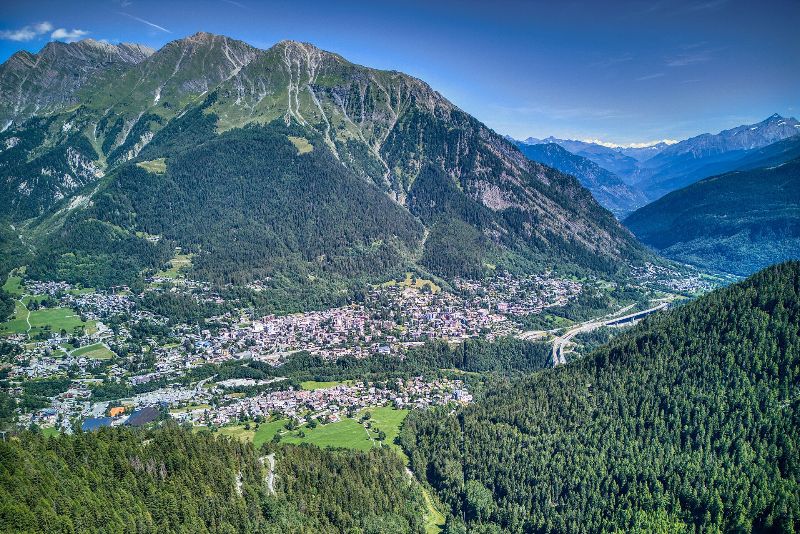
Few places in the Alps match the drama of Chamonix-Mont-Blanc. The town sits at the foot of the highest summit in Western Europe, glaciers hang almost directly above the rooftops, and the ski areas range from gentle nursery slopes to some of the most famous off-piste terrain on the planet. The good news for travellers is that all of this lies only around 90 km from Geneva Airport, a drive of roughly an hour and a quarter in normal conditions. This guide explains how a Geneva Airport to Chamonix transfer works in practice, what to expect on the road, and how to get the most out of the valley once you arrive.
Why Chamonix is the easiest big-mountain trip from Geneva
Most major ski resorts in the French and Swiss Alps involve a long climb up a side valley at the end of the journey. Chamonix is different. The Autoroute Blanche, the A40 motorway, runs almost all the way from the outskirts of Geneva to the mouth of the Chamonix valley, and the final stretch is a wide, well-maintained main road rather than a narrow series of hairpins. That makes the trip short, predictable and comfortable, even with a car full of skis and suitcases.
It also means Chamonix works beautifully for short stays. Many visitors land in the morning, check into their hotel or chalet before lunch and are standing at the top of a cable car by mid-afternoon. For a long weekend, a business trip combined with a few days in the mountains, or a quick visit to see the Mont Blanc massif, the short transfer time is a real advantage.
The drive from Geneva Airport, step by step
Leaving the airport
With a Geneva Airport private transfer, your chauffeur tracks your flight and waits for you in the arrivals hall with a name sign, so a delay or an early landing changes nothing for you. Once your luggage and ski bags are loaded, the car heads out of the airport area and joins the motorway network around the south of Geneva towards the French border.
Crossing into France
Chamonix is in France, so the journey crosses the Swiss-French border shortly after leaving Geneva. Both countries are in the Schengen area, which means there is usually no systematic passport check, but customs officers can and do carry out spot checks. Every passenger should carry a valid passport or national identity card, and travellers from outside Europe should keep their documents handy. Switzerland is not in the European Union customs union, so if you are carrying goods above the duty-free allowances, the rules of both countries apply. For most holidaymakers with personal luggage and ski equipment, the crossing takes no more than a moment.
The Autoroute Blanche
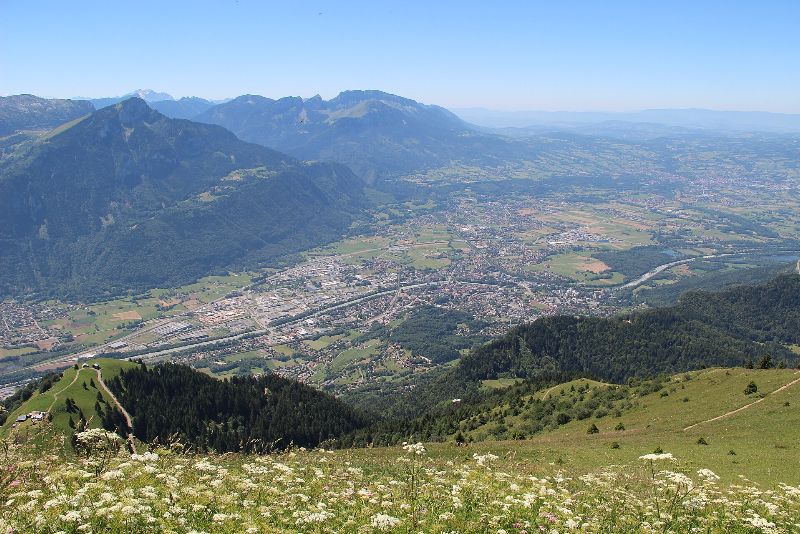
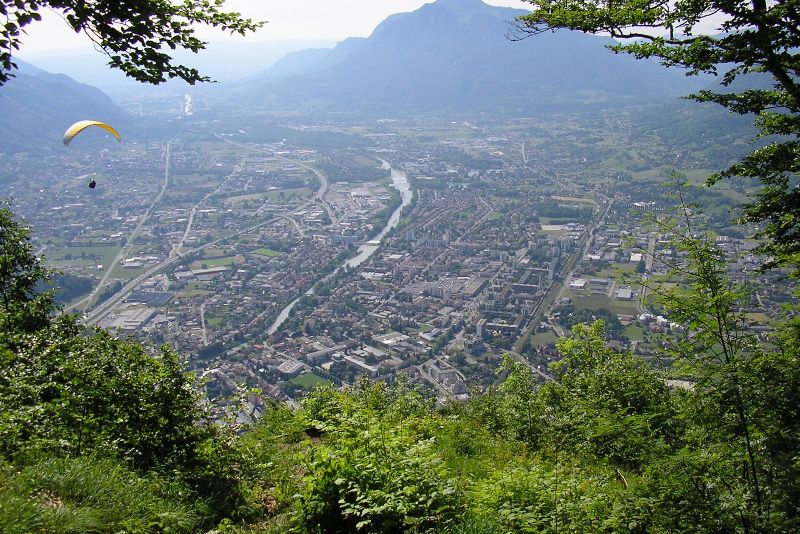
On the French side, the A40 follows the Arve valley past Bonneville and Cluses before reaching Sallanches and Passy. From here the views open up and, on a clear day, the white dome of Mont Blanc dominates the windscreen. The motorway gives way to the main road that climbs gently past Servoz and Les Houches into the Chamonix valley. There are some curves and a long bridge section, but nothing like the tight switchbacks found on the access roads of many other resorts.
Arriving in the valley
Chamonix is not a single compact village but a chain of hamlets and villages strung along the valley floor: Les Houches at the entrance, Chamonix town itself, Les Praz, Les Bois, Argentière and finally Le Tour near the Col de Balme. A door-to-door service matters here, because the right chalet in Argentière and the right hotel in central Chamonix can be fifteen minutes apart, and some chalets sit on steep, narrow lanes above the main road. Your chauffeur drops you at the door, not at a bus stop.
Winter driving and Saturday traffic
The route is short, but it is still a mountain journey. From November to March, French law requires vehicles in mountain areas such as the Haute-Savoie to carry winter equipment, either winter tyres or snow chains. Heavy snowfall can slow the final section into the valley, and the road can occasionally be affected by avalanche control or roadworks. Professional chauffeurs who drive this route regularly know when to leave a margin and how to handle snow-covered roads calmly.
The other factor is the weekly changeover. During the main winter season, especially in February during the French and British school holidays, Saturday is the busiest day on every road between Geneva and the French resorts. Queues can build at the border, on the A40 around Cluses and Sallanches, and in the airport itself. If you have flexibility, arriving on a Friday or Sunday, or travelling outside the late-morning peak, often saves real time. If you cannot avoid a Saturday, a private vehicle at least means you are not waiting for other passengers on a shared shuttle, and you travel on your own schedule.
Getting to know the Chamonix ski areas
Chamonix is not one interconnected ski area but a collection of separate mountains, each with its own character. Moving between them is part of the experience, and it is one reason many guests also book a Geneva Airport chauffeur service by the hour during their stay, so they can be taken from one valley base to another without dealing with parking.
Brévent and Flégère
Rising directly above Chamonix town, the Brévent sector tops out at around 2,525 m and offers one of the finest panoramas of the Mont Blanc massif from any ski area in the Alps. It is linked by cable car to the neighbouring Flégère sector above Les Praz, which reaches roughly 2,500 m. Together they form a good all-round area with sunny, south-facing slopes, red and blue runs, and plenty of terraces for lunch. For the 2026-2027 season the Brévent-Flégère lifts are scheduled to run from 12 December 2026 to 18 April 2027, subject to snow conditions.
Grands Montets
Above Argentière, the Grands Montets has long been the valley's legendary area for strong skiers, with high, north-facing glacier terrain, big off-piste descents and a reputation for holding good snow late into the season. The upper part of the mountain has been through a major renovation programme, so it is worth checking the current status of the top lifts with the lift operator before you plan your days there.
Le Tour and Balme
At the head of the valley, Le Tour and the Balme area are gentle, open and sunny, with wide pistes that reach the Swiss border at the Col de Balme. This is the sector many families and intermediate skiers love most, and it is also a classic place to start for those wanting to try ski touring.
Aiguille du Midi and the Vallée Blanche
The Aiguille du Midi cable car climbs from Chamonix town to 3,842 m, one of the highest cable car stations in Europe. Even non-skiers make the trip for the views and the glass viewing platform. For skiers, it is the departure point for the Vallée Blanche, a descent of around 20 km across glaciers back towards the valley. It is not a marked or patrolled piste: it is high-mountain glacier terrain, and the safe way to do it is with a qualified mountain guide.
Les Houches
At the entrance to the valley, Les Houches has a more wooded, sheltered ski area that is excellent on stormy days when the high sectors are closed or flat light makes open terrain difficult. It is also home to a famous downhill course that has hosted World Cup races.
When to go
The main winter season in the Chamonix valley generally runs from mid-December to mid-April, with the precise dates set each year by the lift operator and dependent on snow. January often brings cold, quiet days and lower crowds. February is the busiest month because of school holidays across Europe. March and early April usually combine longer days, a strong snowpack at altitude and a lively spring atmosphere on the terraces. Outside winter, Chamonix is just as busy in summer for hiking, climbing and trail running, and the transfer from Geneva is identical, minus the snow chains.
Chamonix with children
Families sometimes worry that Chamonix is only for experts. In reality the valley has excellent beginner areas, including dedicated learning zones at the base of several sectors, and Le Tour, Les Houches and parts of Flégère are very well suited to children and progressing skiers. Ski schools operate throughout the valley.
For the transfer itself, a few practical tips help:
- Request child seats when you book, specifying the age and weight of each child, so the right seats are fitted before the car reaches the airport.
- For families with lots of equipment, the Mercedes V-Class carries up to seven passengers with room for skis and boards, which avoids having to squeeze bags around car seats.
- Keep snacks, a water bottle and a change of clothes in a small bag in the cabin rather than in the boot, especially for evening arrivals.
- Because the drive is only around 75 minutes, many young children simply fall asleep and wake up in the mountains.
Where to stay: hotels and chalet areas
Chamonix offers everything from historic grand hotels to contemporary boutique properties and large private chalets. Central Chamonix suits guests who want restaurants, shops and nightlife within walking distance, and it puts the Aiguille du Midi and the Brévent lifts close at hand. Les Praz and Les Bois, a little further up the valley, are quieter and more residential, with some of the most sought-after chalets surrounded by forest and close to the Flégère lift and the golf course. Argentière has a more village feel and suits skiers who want to be near the Grands Montets, while Les Houches offers good value and easy access from the motorway. Many luxury chalets in the valley come with private chefs, spas and concierge services, and a chauffeur arrival fits naturally into that kind of stay.
Winter highlights beyond the pistes
Part of Chamonix's appeal is that it is a real mountain town with a long history, not a purpose-built resort. Winter visitors can enjoy:
- The Montenvers rack railway up to the Mer de Glace, the longest glacier in France, which is a spectacular half-day outing for non-skiers.
- Ice skating, swimming and wellness facilities in town.
- Dog sledding, snowshoe walks and paragliding flights over the valley when the weather allows.
- A lively dining scene, from traditional Savoyard fondue and raclette to modern gastronomic restaurants.
- Day trips through the Mont Blanc Tunnel to Courmayeur in Italy, which a chauffeur by the hour can easily arrange.
Luggage, skis and choosing the right vehicle
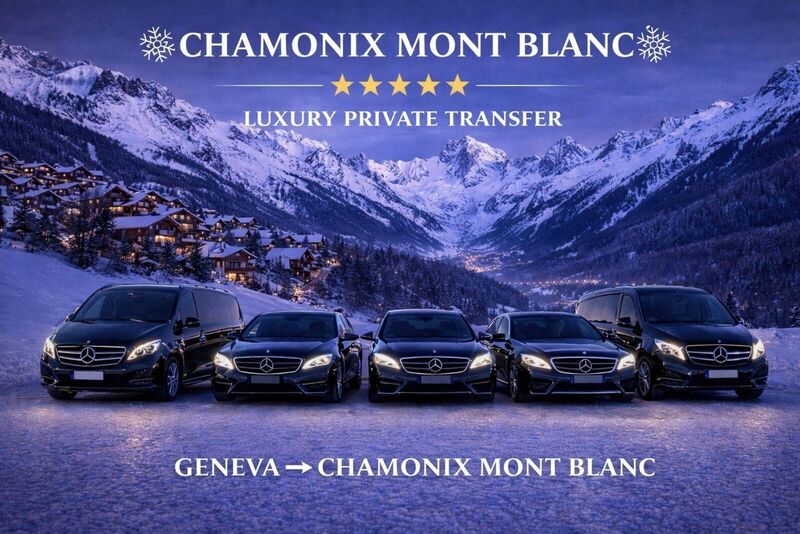
Ski holidays involve bulky luggage, and choosing the right vehicle makes the arrival much smoother. A couple travelling light with a pair of ski bags is comfortable in a Mercedes E-Class business sedan. For a more refined experience, the S-Class first-class sedan is the natural choice for a Geneva Airport limousine service feel. Groups and families with several ski bags, boot bags and suitcases are best served by the V-Class, which seats up to seven and has proper space for long equipment. For larger groups, such as a corporate retreat or several families sharing a chalet, a Sprinter minibus can be arranged on request. In every case, the chauffeur helps load and unload luggage and ski equipment, so you do not have to carry heavy bags across icy car parks.
How booking works
You can book online a private transfer from Geneva Airport in a few minutes. You enter your flight details, your destination in the Chamonix valley, the number of passengers and the amount of luggage, and you see a fixed price before you confirm. Payment is made online by card, Apple Pay or Google Pay. The vehicle is reserved for your party alone: it is a private transfer, not a shared shuttle, so there are no detours to drop off other guests in other villages. Service is available day and night, 24/7, which is reassuring for late evening flights or early morning departures. If you book the return journey at the same time, you receive a 10% discount on the return leg.
A final word on timing your return
On departure day, plan to leave Chamonix with a comfortable margin, particularly on Saturdays in season or after heavy snowfall. Your chauffeur can advise on a sensible pick-up time based on your flight, the day of the week and the weather forecast. With a short, scenic drive, a private vehicle and someone else handling the luggage, the last memory of your stay is the view of Mont Blanc in the rear window rather than the stress of the road.
Geneva Airport to Chamonix-Mont-Blanc: price and distance
Distance by road from Geneva Airport (GVA): about 90 km, around 1 h 15 without traffic. Fixed prices per vehicle (not per person), in Swiss francs, for a private transfer in either direction.
| Vehicle | Passengers | One way, Mon–Fri | One way, Sat–Sun | Round trip, Mon–Fri |
|---|---|---|---|---|
| Business Sedan · Mercedes E-Class | 3 · 2 Suitcases | CHF 370 | CHF 410 | CHF 700 |
| First Class Sedan · Mercedes S-Class | 3 · 2 Suitcases | CHF 480 | CHF 530 | CHF 910 |
| Luxury Van · Mercedes V-Class | 7 · 8 Suitcases | CHF 425 | CHF 470 | CHF 805 |
Weekend transfers (Saturday and Sunday) cost 10% more. The return leg of a round trip is 10% cheaper. The exact price for your address and date is shown in the booking form before you pay.